Course Introduction:
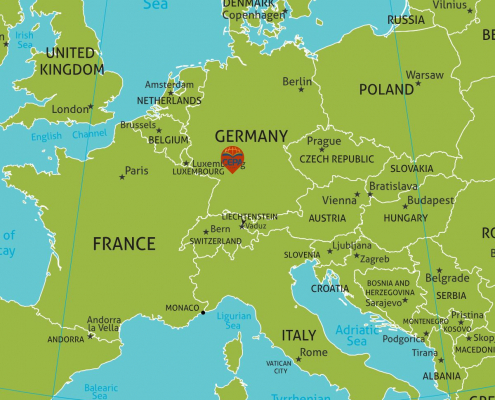
Germany has played a central role in the development of mathematics, physics, and engineering. Among the most influential figures is Gottfried Wilhelm Leibniz, who is widely credited as a co-inventor of calculus. Born in Leipzig in 1646, Leibniz introduced many of the concepts and notations still used today, including the notation for integration and differentiation. His work laid the foundation for modern calculus and continues to shape the mathematical tools we study in this course.
In this course you will cover material related principally to Multivariable Calculus, also known as Calculus III. Multivariable calculus is the fundamental to Science and Engineering. This course will extend the concepts learned in Calculus I and II. The content of this course will thus focus on curves and surfaces in Euclidean 3-space, length and curvature, area and volume; surfaces, partial derivatives, total differential, tangent planes to surfaces; gradient; vector-valued functions; line integral; Stokes’ theorem, Green’s Theorem, and the Divergence Theorem.
In addition to the cognitive and knowledge skills listed above, students in this course will consider the contributions of the Germans in science, mathematics, technology, and engineering through experiential learning components.
Syllabus:
CEPA-ESC-Heidelberg-Multivaiable Calculus (Calc III) – Math 200 (4 credits).pdf